How Volleyball Scoring Works and What the Game Is Played To
Learning how volleyball scoring works and what the game is played to comes down to three basics: rally scoring, a target score for each set, and the win-by-two rule. The scoreboard can change on every rally, and a set can keep going past its target if the margin is too tight.
How volleyball scoring works
Volleyball uses rally scoring, which means one team earns a point after every rally. If the serving team wins the rally, it scores and keeps serving; if the receiving team wins it, that team scores and takes the next serve.
A rally starts with the serve and ends when the ball hits the floor, a team commits a fault, or the referee stops play for a violation. Points can come from a kill, an ace, a block that lands in, a ball hit out, a net violation, or a serving error.
Every serve matters in rally scoring. Older side-out scoring only gave points to the serving team, but modern volleyball counts every rally.
What score volleyball games are played to

Indoor volleyball commonly plays a standard set to 25 points, and the team must win by 2. A deciding set often goes to 15, also with a two-point margin.
Formats can vary by league, age level, school association, tournament, and ruleset. Fans often say “game” when they mean one set, but formally, a match is the full contest made up of multiple sets.
Scoring a set
A team wins a set by reaching the target score while leading by at least 2 points. If the target is 25 and the score reaches 25-24, the set continues because the lead is only one.
Play goes on until one side creates a two-point gap, such as 26-24 or 27-25. The win-by-two rule keeps a set from ending on the narrowest possible margin.
Scoring the match
A match is decided by set wins, not total points across the night. The winner is the team that wins the required number of sets under that competition’s rules.
Many indoor matches use a best-of-five format, while some school, recreational, or tournament matches use shorter formats. Each set is scored separately, then set wins decide the match.
The win-by-two rule
The win-by-two rule means a team must reach the target score and lead by at least 2 points. If the teams stay tied near the target, the set keeps going until one team pulls ahead.
For example, if a set is played to 25 and the score is 24-24, the next point makes it 25-24, not a finished set. The leader still needs one more point to win 26-24. If the opponent scores instead, it becomes 25-25, and play continues.
Standard win-by-two scoring has no automatic stop at the target score. The target shows when a team can win, not when the set must end.
Serving, rotation, and points
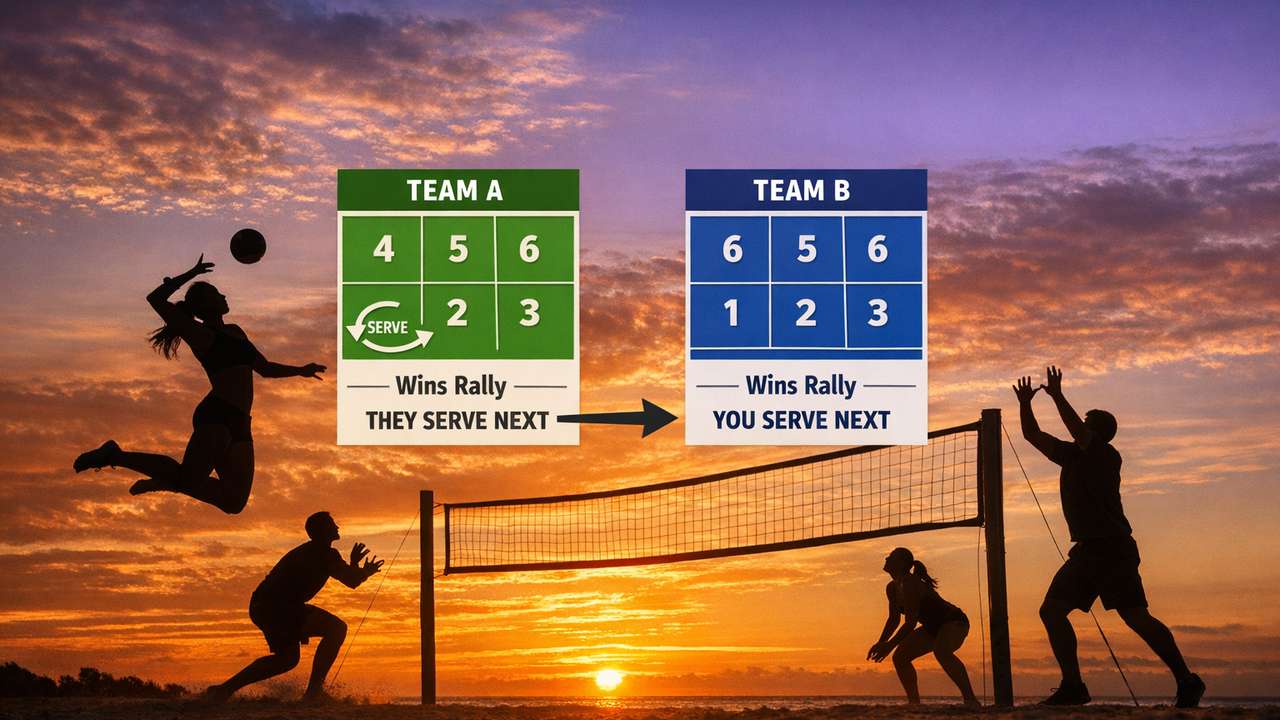
Serving changes follow rally scoring. The team that wins the rally scores the point and serves next.
If the serving team wins the rally, the same player continues serving. If the receiving team wins it, that team scores, gains the serve, and becomes the serving team for the next rally.
In indoor volleyball, a team rotates when it wins the right to serve back from the opponent. Players move through the rotation order, and the player who rotates into the serving position serves next.
The receiving team no longer has to win the serve before it can score. Winning the rally gives that team both the point and the next serve, so momentum can swing quickly after a side out.
Volleyball scoring terms and what they mean
These volleyball scoring terms explain how points, sets, serves, and match results work.
- Rally scoring: A scoring system in which one team earns a point after every rally, regardless of which team served.
- Set: One segment of a volleyball match, usually played to a target score with a two-point winning margin.
- Match: The full contest made up of multiple sets.
- Set point: A point on which one team can win the set by winning the rally.
- Match point: A point on which one team can win the match by winning the rally.
- Side out: The receiving team wins the rally, scores a point, and earns the next serve.
- Rotation: The clockwise movement of indoor players after their team wins back the serve.
- Win by two: The requirement that a team lead by at least 2 points to win a set.
Indoor vs beach volleyball scoring
Indoor and beach volleyball both use rally scoring and the win-by-two rule, but their set targets and match formats differ. Indoor volleyball uses six players per side and often plays longer matches; beach volleyball uses two players per side and usually plays shorter matches.
| Category | Indoor volleyball | Beach volleyball |
|---|---|---|
| Players | Six players per team on court | Two players per team on court |
| Common match format | Often best of five sets | Usually best of three sets |
| Common set targets | Non-deciding sets commonly to 25; deciding set often to 15 | First two sets commonly to 21; deciding set often to 15 |
| Win condition | Must win each set by 2 | Must win each set by 2 |
| Side changes | Teams change sides between sets and as rules require | Teams switch sides during sets more often to balance outdoor conditions |
| Rotation | Indoor teams rotate when winning back the serve | Beach has service order but no six-player rotation |
Common scoring examples
These examples show how rally scoring, serving, set targets, and match formats affect the scoreboard.
-
A team wins a rally while serving. The team gets 1 point, keeps the serve, and the same server continues unless a rule or substitution changes the lineup.
-
A team wins a rally while receiving. The team gets 1 point, wins the right to serve next, and in indoor volleyball rotates before the next serve.
-
A set reaches the target score by only one point. If the target is 25 and the score is 25-24, the set continues because the leader has not won by 2.
-
A match is decided by sets. If the format requires three set wins, the first team to win three sets wins the match, even if the other team scored more total points across all sets.
FAQ
These quick answers cover common volleyball scoring questions.
Is volleyball scored on every rally?
Yes. Modern volleyball uses rally scoring, so every rally gives one team a point.
Can a volleyball set go past 25 points?
Yes. A set can go past 25 when the leading team is ahead by only one point, and play continues until one team leads by 2.
What is the difference between a set and a match in volleyball?
A set is one scored segment of play. A match is the full contest, and set wins determine the winner.
Who serves after a point in volleyball?
The team that wins the rally serves the next point. If the receiving team wins the rally, it scores, gains the serve, and rotates in indoor volleyball.
Are volleyball scoring rules the same for school, club, and Olympic matches?
Not always. Rally scoring and win-by-two are widely used, but set targets, match length, and procedures can vary by level, league, and ruleset.